Physical AI Infrastructure Engineer
- Location
- Gardena
- Workplace
- On-site
- Employment
- Full-time
About this role
What you’ll work on
- Improve our data annotation pipeline. Clean up existing workflows, improve data validation and labeling tools, and make it easier to turn robot demonstrations and deployment data into useful training datasets.
- Maintain and improve teleoperation software. Improve how operator inputs translate into robot behavior, including action smoothing, motion mapping, responsiveness, and debugging tools.
- Develop and evaluate manipulation capabilities. Work with inverse kinematics and motion control for new arms, including 7-DoF redundancy, elbow clearance, camera visibility, and compliant grasping.
- Test prototype hardware. Write CAN communication and hardware test code for new R&D systems. Evaluate whether AMR base, lift, arm, and gripper interfaces provide the control, feedback, and timing needed for new behaviors.
- Make hardware changes easier. Build calibration tools and model input/action adapters that help us move between different arms, grippers, and cameras.
- Verify real task outcomes. Work with the AI team to detect whether a task actually succeeded, investigate false success signals, and evaluate rewards against physical results.
- Measure what improved. Build repeatable tests that isolate the effects of model, controller, and hardware changes.
- Keep R&D work reusable. Bring experimental branches into a shared codebase with clear interfaces, versioned configurations, tests, and documentation so other engineers can reproduce and extend the work.
What we’re looking for
- Strong software engineering skills in Python and C++, with experience writing and debugging code that interacts with physical hardware.
- A strong understanding of robotic kinematics, coordinate frames, inverse kinematics, and motion control.
- Hands-on experience with robot arms, teleoperation, or related robotic systems.
- Experience writing and debugging CAN communication with actuators or other hardware.
- The ability to design useful experiments, define success criteria, and diagnose problems across software and hardware.
- Good engineering habits: readable code, practical tests, clear documentation, and comfort integrating work across Git branches.
- Comfort taking an open-ended problem from an initial prototype to a reliable tool that teammates can use.
Helpful experience
- Robotics data pipelines, annotation tools, or dataset quality evaluation.
- Robot learning, imitation learning, reinforcement learning, or model evaluation.
- ROS/ROS 2, robot calibration, redundant manipulators, or force and compliance control.
- Experience with cloud providers
Apply to Yondu
Clera fills in Yondu's application for you.
How it works
Open the role in Clera
Sign in, and this role opens on your Clera job board, ready to apply.
Clera fills in the application
Clera fills the form from your profile and resume, and asks what's missing.
Track it in Clera
Each application you send shows up in your Clera tracker, sorted by stage.


Ask your AI about this role
It knows you. Clera gives it the role.
First time? Connect Clera once, about a minute.
https://mcp.getclera.comSign in with your Clera account. MCP docs
About Yondu
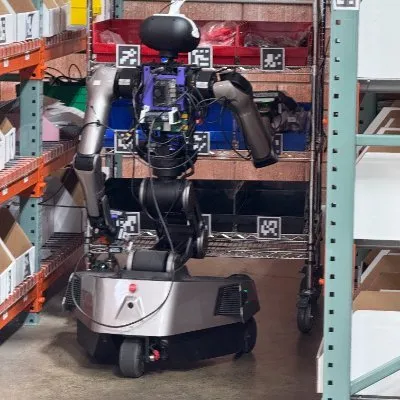
Yondu is creating the robotic workforce of the future, starting with logistics automation. It builds robot foundation models to enable off-the-shelf robots to operate autonomously and is developing an in-house teleoperation system to train these models. Its work spans classical robotics and integration to enable real-world deployments in the robotics and logistics automation space. Yondu was founded by MIT students and raised seed funding after graduating from the YC W24 batch.
- Team size
- 2-10 employees people
- Founded
- 2023
- Industry
- Hardware
- Workplace
- On-site
- Locations
- Gardena, California, United States