About this role
What you'll do
- Develop and improve features across our ROS2 stack in C++ and Python - navigation, mapping and localization, perception, and motion behaviors and ship them to robots running on NVIDIA Jetson and Custom Platforms.
- Tune and debug autonomous navigation and obstacle avoidance so Robots move safely and efficiently through dynamic, human-occupied warehouse aisles.
- Build and improve teleoperation and human-in-the-loop tooling that lets operators monitor, assist, and recover robots remotely.
- Contribute to integrations between our robots and warehouse management systems so tasks flow correctly between the WMS and the fleet.
- Containerize and deploy software with Docker across our fleet, and help commission and troubleshoot robots on-site at warehouse deployments.
- Own features end-to-end; from prototype, through testing, to reliable behavior on real hardware and feed what you learn in the field back into the product.
What we're looking for (must-haves)
- 0–2 years of experience (internships, research, and robotics competition teams count) building software, ideally in robotics, autonomous systems, or another physical/hardware domain.
- BS in Computer Science, Robotics, Electrical/Mechanical Engineering, or a related field or equivalent hands-on project experience.
- Working proficiency in C++ and Python.
- Comfort in a Linux/Ubuntu command-line environment and with Git in a team setting.
- Genuine interest in how software meets hardware (sensors, motors, embedded compute like Jetson/Raspberry Pi), demonstrated through projects, internships, or competition teams in areas like computer vision, autonomous navigation, or motion planning.
- Hands-on experience with ROS2 (or a similar pub/sub middleware) a strong candidate from a ROS1 or custom-middleware background can ramp quickly.
- Exposure to real robot hardware deployment, or to WMS/logistics/warehouse systems.
Nice to haves
- Experience with Docker or other containerization.
- Robotic Manipulation
- Coursework or projects in SLAM, perception/computer vision, motion planning, or sensor fusion.
- A Master's degree in a robotics-related field is a plus, but is not required or expected.
Why you'll want to work here
- Real robots, real production: your code runs on robots doing real work in real warehouses, not just in simulation.
- Ownership: you'll own meaningful features early and see them through to the field.
- Mentorship: you'll learn directly from senior roboticists who care about growing you.
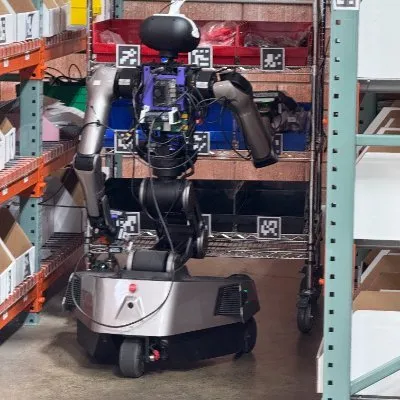
- Hardware access: hands-on time with AMRs, Humanoid Robots, manipulators, high powered compute, and a full sensor suite.
Logistics
- On-site in the LA area, with regular time at customer warehouse sites for deployments.
Apply to Yondu
Clera fills in Yondu's application for you.
How it works
Open the role in Clera
Sign in, and this role opens on your Clera job board, ready to apply.
Clera fills in the application
Clera fills the form from your profile and resume, and asks what's missing.
Track it in Clera
Each application you send shows up in your Clera tracker, sorted by stage.


Ask your AI about this role
It knows you. Clera gives it the role.
First time? Connect Clera once, about a minute.
https://mcp.getclera.comSign in with your Clera account. MCP docs
About Yondu
Yondu is creating the robotic workforce of the future, starting with logistics automation. It builds robot foundation models to enable off-the-shelf robots to operate autonomously and is developing an in-house teleoperation system to train these models. Its work spans classical robotics and integration to enable real-world deployments in the robotics and logistics automation space. Yondu was founded by MIT students and raised seed funding after graduating from the YC W24 batch.
- Team size
- 2-10 employees people
- Founded
- 2023
- Industry
- Hardware
- Workplace
- On-site
- Locations
- Gardena, California, United States